SI Digital is challenging event professionals to think beyond the next exhibition — and design stands for the second, third and even sixth use.
Most exhibition projects start with a very specific question: What do we need for this event?
This quickly leads to more questions like:
What is the stand space?
What does the brand want it to look like?
How will visitors experience it?
But according to Konrad Geyser, CEO and Owner of SI Digital, there is another question worth asking at this stage:
How many events can this build serve?
The idea is not simply to make a stand more sustainable. It is to make one investment work harder.
Design for the second use
SI Digital designs, manufactures and installs exhibition stands, retail pop-ups, brand activations and point-of-sale displays. Its approach considers what happens throughout a structure’s life — from design and material selection through to transport, dismantling, storage, reuse and reconfiguration.
For SI Digital, reuse starts at the beginning of a project — not after the event is over.
“If you’re thinking about reuse only once the stand has already been built, you’ve missed a lot of the opportunity,” says Geyser. “The second use needs to be considered during the design process.”
That means considering how a structure will come apart, how easily it can be transported and stored, and whether its components can work in a different configuration or at a different venue.
The result can be a stand that adapts to different floorplans, events and cities.
Mini Case Study #1: One build. Six events.
SI Digital’s own projects show what this can look like in practice.
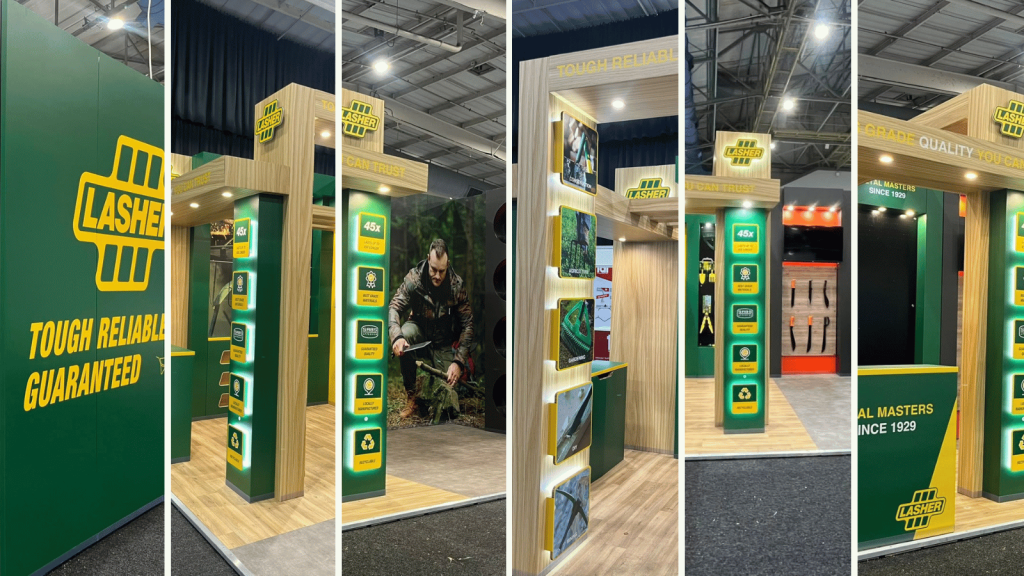
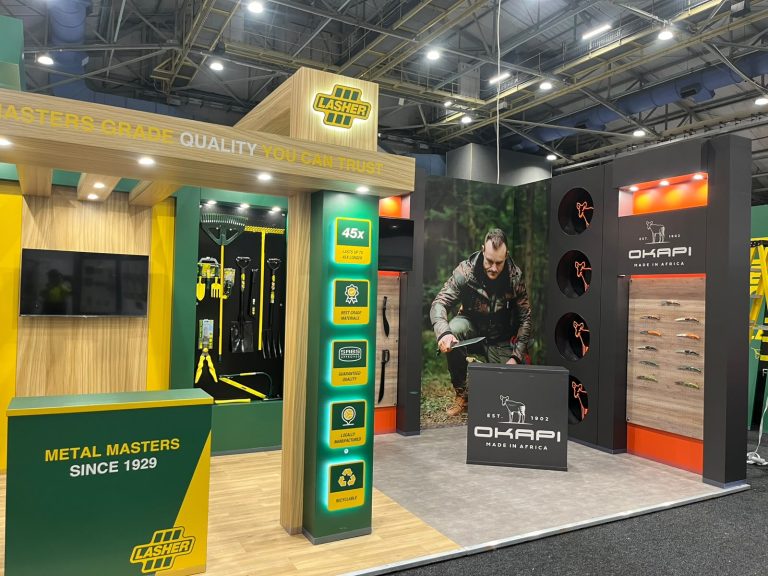
Two of the company’s stands for Lasher and Okapi have each been built more than six times during 2026.
The same components have been dismantled, transported, stored and rebuilt rather than a completely new stand being produced for every event. That reduces the need for new production each time — but Geyser also points to the commercial value of the approach.
“If a stand can be used six times instead of once, you’re getting six opportunities to generate value from what you’ve already designed and produced,” he explains.
“Our storage, maintenance, refurbishment and reconfiguration services help clients extend the useful life of their stands instead of treating them as once-off builds.”
This is where sustainability and business efficiency can work hand in hand: getting more value from the original investment while reducing the need for repeated production and new materials.
Mini Case Study #2: L'Oréal Paris Elvive
Reuse can become more complicated when a stand needs to travel between cities and adapt to different venues. That’s where adaptability becomes just as important as reuse.
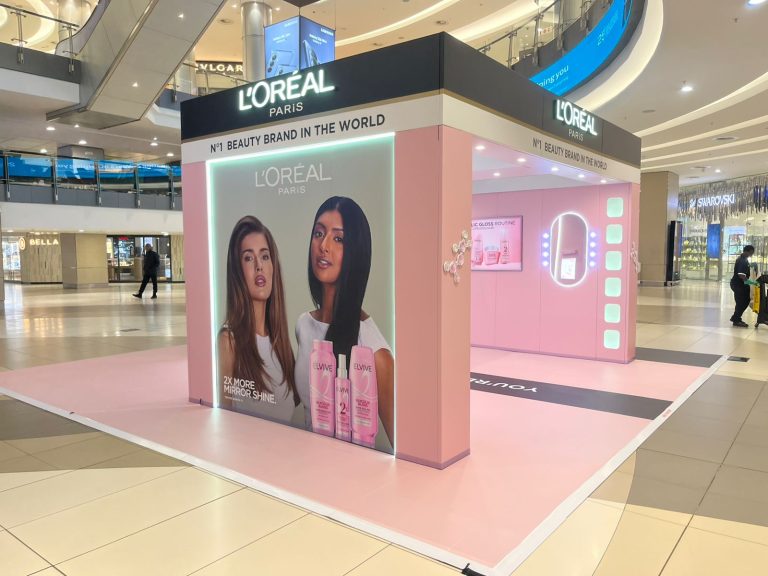
SI Digital’s L’Oréal Paris Elvive mall activation travelled from Sandton City in Johannesburg to Gateway in Durban and then to the V&A Waterfront in Cape Town.
The activation needed to meet the expectations of a premium international beauty brand while also being practical enough to dismantle, transport and rebuild.
For Cape Town, the structure had to be adapted to accommodate height restrictions at the venue.
The result shows that designing for reuse doesn’t have to mean compromising on a polished, creative brand experience.
Green good looks
On the point of appearance, Geyser adds, “A common misconception about sustainability is that it automatically means basic, rustic or visually compromised. There is a perception that sustainable materials have to look obviously ‘green’, or that using fibreboard means accepting a lower-end finish. However, with good design and modern production methods, sustainable materials can be used to create highly finished, premium environments.”
What happens after the event?
For Geyser, introducing one simple question into the briefing can change the conversation between the brand, designer, agency and supplier: What happens to this after the event?
It opens up new possibilities:
Could the stand be used again?
Could it work in a different configuration?
Can it be transported efficiently?
What needs to change for the next venue?
Which elements could remain the same, and which could be refreshed?
These decisions are much easier to make when they are considered before production begins.
A small question that can lead to better design
SI Digital’s approach isn’t about saying every stand must be reused six times, or that every component will have the same lifespan. It is about making reuse and future value part of the conversation from the beginning.
So, at the next briefing, alongside questions about budget, footprint, branding and visitor experience, ask one more:
What happens to this after the event?
It might just change what gets built in the first place.
Interested in finding out more about SI Digital and its professional services?
Connect wth SI Digital to find out more.
LinkedIn: @SI-Digital-(Pty)-Ltd
Website: sidigital.net
QUICK FIRE WITH KONRAD GEYSER
One word that sums up your approach to event greening:
Responsibility
One thing you’d like event professionals to do differently:
Plan for the second use
One word for the future of sustainable event design:
Accountability