Dear EGF Members,
Every year, Earth Overshoot Day serves as a stark reminder that humanity is consuming nature’s resources faster than our planet can regenerate them.
This year, Global Earth Overshoot Day falls on 30 July 2026. In simple terms, by the end of July humanity will have used all the biological resources that the Earth can naturally regenerate during the entire year. From that day forward, we begin living on what could be described as “ecological credit”—depleting natural capital that future generations will depend on.
Unfortunately, the picture is even more concerning here at home. South Africa’s Country Overshoot Day fell on 4 July 2026—almost four weeks earlier than the global average. This means that if everyone on Earth lived and consumed resources in the same way as the average South African, we would require almost two Earths to sustain our lifestyles.
Rather than leading the way in responsible resource management, South Africa is consuming its natural capital at a faster rate than the world as a whole.
That should concern every one of us.
Our country already faces significant environmental challenges. Water scarcity continues to threaten communities and businesses, our biodiversity is under increasing pressure, landfill sites are reaching capacity, and many municipalities struggle with waste management and recycling infrastructure. We simply cannot afford to continue consuming resources as though they are unlimited.
For those of us working in the events, exhibitions and business events sector, this message carries particular significance. Our industry has an incredible ability to connect people, stimulate economic growth, create employment and showcase innovation.
Yet behind the polished exhibition stands, spectacular event experiences and world-class productions lies another reality that is often hidden from delegates and visitors.
Over the years, I have had the opportunity to walk through the waste compounds and loading areas after several major exhibitions have closed.
What I witnessed was genuinely confronting.
Perfectly usable exhibition stands, timber structures, carpets, vinyl graphics, printed banners, signage, furniture, packaging and décor were piled into enormous waste skips, destined for landfill after only a few days of use.
I left those exhibitions both horrified and deeply saddened. Not because waste is unavoidable—but because so much of it is entirely preventable.
Every one of those discarded materials represents energy consumed during manufacturing, water used in production, carbon emitted during transport, labour invested in construction, and natural resources extracted from our environment. When they are sent to landfill after a single event, the environmental cost extends far beyond the exhibition hall.
As an industry that prides itself on innovation and creativity, we should be asking ourselves difficult questions.
Why are temporary structures still being designed for single use?
Why are recyclable materials not becoming the default rather than the exception?
How can we design exhibition stands that are modular, reusable and repairable?
How do we encourage exhibitors to think beyond the next event and consider the full life cycle of the materials they specify?
These are not simply environmental questions—they are business questions, procurement questions and leadership questions.
The encouraging news is that the solutions already exist. Around the world, exhibition organisers are embracing circular economy principles, modular stand systems, reusable graphics, sustainable procurement policies, waste separation programmes and material recovery initiatives. South Africa has the creativity, expertise and innovation to do the same.
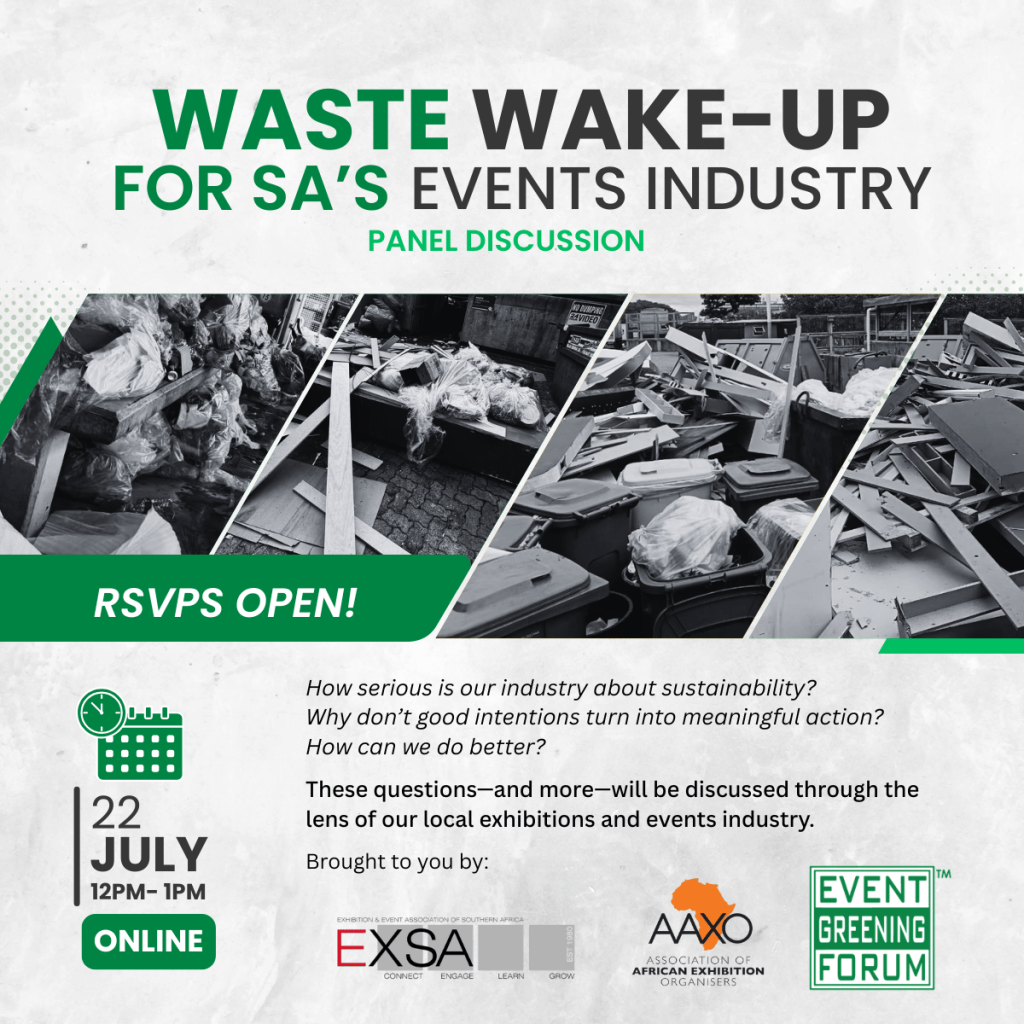
This is why the timing of our upcoming webinar could not be more appropriate. On 22 July 2026, the Event Greening Forum, together with EXSA and AAXO, will host our online panel discussion entitled “Waste Wake-Up for SA’s Events Industry”. I have the privilege of facilitating this important conversation alongside respected industry leaders who are passionate about driving meaningful change.
The webinar will explore the realities of exhibition waste, challenge our current thinking, and, most importantly, focus on practical solutions that can help our industry reduce waste and embrace more sustainable practices. Join the conversation, and RSVP here.
In many ways, this discussion is a direct response to South Africa’s Earth Overshoot Day.
If South Africa is already consuming resources at a rate that exceeds the global average, then every industry has a responsibility to play its part in reversing that trend. The events and exhibitions sector is no exception.
The Event Greening Forum exists as the leading authority to educate, advocate, inspire and support our industry on this journey. Sustainability is no longer a niche topic or an optional extra—it is fundamental to ensuring the long-term resilience of our businesses, our industry and the natural environment on which we all depend.
Earth Overshoot Day should not simply be another date on the calendar. It should be a catalyst for action.
As professionals who create experiences for thousands of people every year, we have an extraordinary opportunity—and indeed a responsibility—to demonstrate that successful events can also be environmentally responsible events.
I encourage every member of our industry to join us on 22 July as we begin what I hope will become one of the most important conversations our sector has had in recent years. Because if South Africa is to move its Earth Overshoot Day later into the year, every industry must contribute.
The question is no longer whether we need to change. The question is whether we are prepared to lead that change.
Warm regards,